Mary Immaculate College
Graduation (1)
Friday 23rd Oct 2009
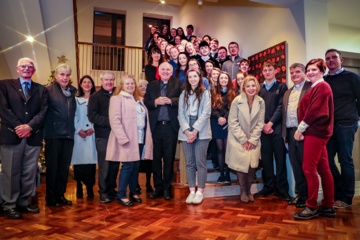
I am very glad to welcome and congratulate all of you who are receiving degrees and awards today, and I offer a particular word of congratulation to those who will be conferred with doctorates. I welcome your families and friends to the College to share this day with you. And I express my appreciation of the academic and administrative staff of the College who accompanied and guided and inspired you on your journey to this Graduation Day. You, the graduands, know very well that these awards are the fruit of your efforts, but also of many dimensions of the life and work of the College. The support and encouragement that you received here from so many people, and not least from one another, played an important part in reaching this goal. But most of all the achievement is yours and I hope that you enjoy this well deserved day of celebration.
Your time here has, I am sure, been a period of intense and exhausting effort – especially coming up to exams! Now you may understand more clearly what Pope John Paul meant when he talked about the danger that the human mind may wilt under the weight of so much knowledge [1]
You have, I hope, learned a great deal during your time in the College. One of the challenges of modern university education is to retain the idea that a university is a community of learning. Our knowledge has become vastly extensive and complex and weighty. Disciplines become more and more specialised. Even within the same department people may not know very much about the areas in which their colleagues are specialising. The danger is that knowledge will be fragmented. No one could keep up with every area of knowledge; they would certainly wilt under the weight! Yet how can anyone make sense of life as a result of a whole series of inputs whose relationship to one another remains unclear?
You can of course take refuge in the words attributed to Albert Einstein: “Education is what remains after one has forgotten what one has learned.” I don’t want in any way to play down the importance of the things you have learned. Still, now that I am at an age when I have long forgotten most of what I learned, I like to think that the quote may be true.
But the most important subject you have been learning here is yourselves as individuals and ourselves as a community and humanity as one family. During your time in the College, you have not just been acquiring knowledge and skills; you have been growing as whole persons and in your ability to relate sensitively and respectfully to other people. That’s the most fundamental aim of education. Our Mission Statement says that the College “seeks to foster the intellectual, spiritual, personal and professional development of students within a supportive and challenging environment that guarantees the intellectual freedom of staff and students.”
All the varied subjects that are taught here do come together. They come together in all sorts of different combinations in those who teach and those who learn. By ‘those who teach and those who learn’ I don’t just mean the academic staff and students. Everybody in the academic community is both a learner and a teacher.
In the Middle Ages one person might hope to be familiar with every area of knowledge; that will never be true again. But we can see our search for truth and beauty within a context which unites the whole human quest. That context has to be the search for answers to the fundamental questions that education poses: Who am I? Who are we? Where is there a meaning big enough to make sense of life with all its tragedies and stupidities and injustices with all its promise and potential?
That is what Catholic/Christian education has to offer. That is why, for all the disputes and mistakes that were made on every side in the course of history, it has remained always open to learning and art and science no matter what their source. It is founded on a vision of the human person which recognises that the unlimited potential is not unrealistic because God’s Son has pointed the way to a world where there will be no more mourning or weeping and all things will be made new. So there were no limits to the field of knowledge. One historian of Christian Europe said that the same group of monks could include “scholars and poets, philosophers and biblical commentators, geographers and cosmographers, grammarians and philologists and lexicographers”. He described them like this “They liked to show off their learning, to parade their knowledge of Greek… to indulge in fanciful speculation, to take part in loud unending disputations” [2]. On second thoughts, they might not be out of place in a modern university!.
I wish you who are graduating every success in the future. I hope that what you have learned here, not just your studies, but what you have learned through your studies and through the life of the College about yourselves, about what it means to be fully human, about what the Word of God opens up to humanity, will be a light for your path as you move into a new stage of your lives. You do so with our prayers and good wishes and our confidence and pride in you. Comhgáirdeas libh uile is go gcuire Dia rath ar bhúr saothar.
_________________________
Cf. JOHN PAUL II, Fides et Ratio, 5.
Ó FIAICH, in An Introduction to Celtic Christianity, ed. Mackey, J., Edinburgh 1989., p. 119.
|