Franciscan Friars of the Renewal
Moyross
Saturday 18 August 2007

As Elijah stood waiting on the mountain, the Lord did not come to him in the great and strong wind, or in the earthquake, or in the fire. The Lord was in a still small voice, in what one Bible translation calls ‘a sound of sheer silence’ (NRSV). But when the Holy Spirit came on the disciples at Pentecost it was a complete contrast: it was like the rush of a mighty wind and like tongues of fire.
God is infinitely beyond us and our ideas. So we can expect that kind of contrast that when we try to think about him. God is both gentle and powerful. On Calvary, God’s only Son hangs in agony mocked and betrayed and yet, in the very same event, he is being lifted up from the earth, drawing all of us to himself. The Holy Spirit expresses the message of God in many tongues and yet, the same Spirit speaks in our hearts with sighs too deep for words (Rom 8:26).
It is not that we cannot find God in great and powerful events like earthquakes and fires. The lesson that Elijah learnt is that God is everywhere and that we should expect to find him in the most unlikely places. The lesson is that we should listen carefully in case we miss his voice.
That was what the two disciples walking along the road discovered. They were downhearted and sad, and they met a stranger who spoke with them. They had no idea how extraordinary that journey was until, that evening, he took bread and blessed it and broke it and gave it to them. Then, in the simple, ordinary experience of sharing a meal, they recognised Jesus, risen from the dead. Their sadness and despair were transformed and they realised that, all along, their hearts had been burning within them as he spoke to them. Then they were able to stop being weighed down at all the terrible things that had happened on Good Friday and to open their minds to listen to a truth that was greater than they had ever imagined.
The disciples recognised him in the breaking of the bread – in other words, they recognised him in the sign which he gave at the Last Supper when he broke bread and gave it to his disciples saying, “This is my body”. They recognised him not in wind or fire or earthquakes but in the sign of Bread, broken and given to them.
This Parish is called – Corpus Christi, the Body of Christ. It is dedicated to Jesus’ gift of himself to us in the Eucharist. In this Church, here in this Parish, the Lord Jesus, who sits at the right hand of God in unimaginable glory, is with us not in wind or fire or earthquakes but in the Blessed Eucharist, in his Word that has just been read, and in his people, in other words, in each one of us.
He is with us all the time. But sometimes we are not listening carefully enough. We are weighed down by all sorts of things – perhaps it is a real aching sadness about someone who has died, perhaps it is a feeling of depression because things never seem to get any better, perhaps it is worry about sickness or about family members in some sort of trouble, perhaps it is fear of what drink or drugs or violence can do to people and to the community, perhaps it is a temptation to lose heart because we are disappointed that all our efforts haven’t achieved everything we hoped.
But this community is not just called the Body of Christ. It is the Body of Christ. He is walking with us on the roads of Moyross just as much he walked with the disciples on the road to Emmaus.

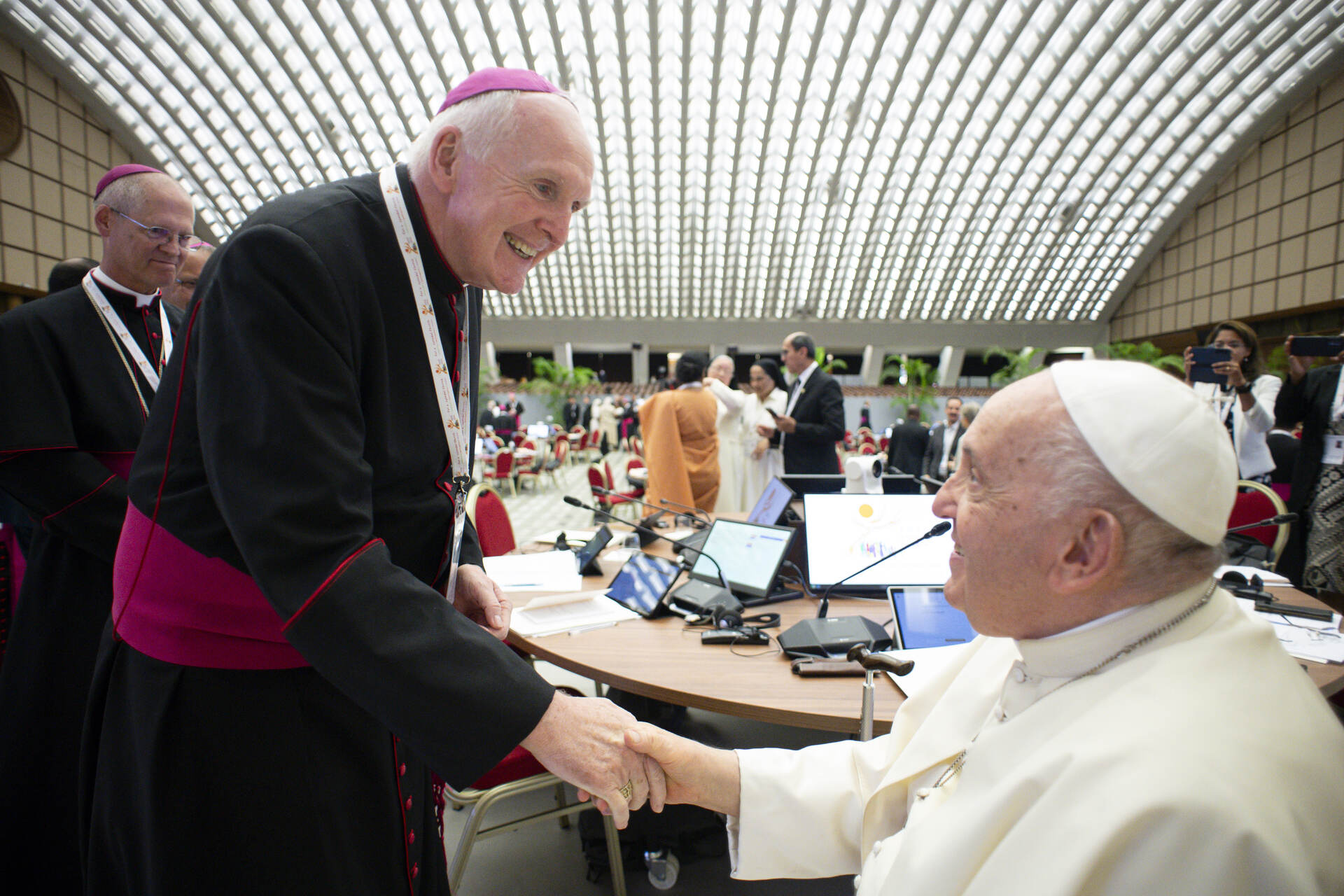
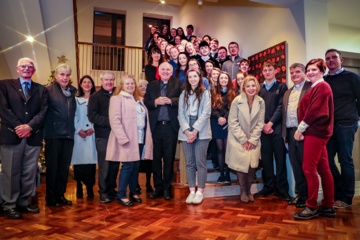
Blessing of St. Patrick's Friary, Moyross, Limerick.
(Left to right) Fr. Sylvester of the Franciscan Frairs of the Renewal (Moyross),
Bishop Donal Murray, Fr. Bernard Murphy and Fr. Frank O' Dea,
Parish Priest of Corpus Christi Parish, Moyross.
Today we welcome into this community of the Body of Christ, the Franciscan Friars of the Renewal. Saint Francis was a person who had learned to listen and to find God in every person and in every creature. He listened with all his heart and understood what was important in life. He gave up everything he had, his position, his wealth, his reputation. And giving up everything didn’t make his life miserable and restricted; he was one of the freest people that ever lived.
He was free because he knew that what really matters in life is to love God with our whole heart and soul and might and to love our neighbours as ourselves. A life which is focused on that goal is one through which God fulfils the prayer of St Francis, which is so much associated with the Franciscan tradition a prayer for the transformation of what weighs us down into the peace and joy of God.
Lord, make me an instrument of your peace,
Where there is hatred, let me sow love; where there is injury, pardon;
where there is doubt, faith; where there is despair, hope;
where there is darkness, light; where there is sadness, joy;
The Franciscan Friars who are coming to live in this community are following in that tradition of finding real freedom and joy in following Jesus wholeheartedly and of sharing the fruits of that freedom and joy with the whole community. We ask God today to bless them and their presence among us. We ask God to help them, and all of us, to listen to the truth that sets us free. May the new Friary of St Patrick help us to appreciate, in the words of the prayer associated with St Patrick, that Christ is always beside us, before us, behind us, within us below us and above us.
+Donal Murray
Bishop of Limerick
|