Spiritual Aspects: Faith
Mount Merrion
Tuesday 14 March 2006
A WORLD GROWN DEAF
Just over fifty years ago I had the privilege of serving the first Mass in the new Church of St Thérèse. It is startling to realise how dramatically Ireland and the world have changed in the intervening years. It would have seemed unthinkable fifty years ago that we could be facing the possibility that the generations that come after us will not receive from us the torch of faith which has been handed down for so many generations in this country.
When people talk about the future of the Church in Ireland, the usual issues are prominent in the discussion – celibacy, child abuse, lay involvement, the role of the Church in education, vocations etc. The most important issue lies much deeper. The challenge that faces us, to put it simply, is the question of continuing to believe in God in the world of the twenty-first century with all its uncertainties. That is the fundamental issue for us as followers of Christ. We are faced with a situation which might be summed up in words Pope John Paul spoke about what he called “secularised existence” “Many persons (…) live as though God did not exist and (…) place themselves outside the problem of faith versus non-belief, since God has, as it were, disappeared from their existential horizon.”
At the heart of every culture, according to his encyclical, Centesimus Annus, lies the attitude that human beings take to the mystery of God. Our culture has become increasingly secularised. We have what is a very rare phenomenon in history – a culture that in many respects tries to build itself on the assumption that the attitude that human beings take to the mystery of God is of no social relevance.
What that means is that social life – politics, economics, communications and so on – to a large extent lacks the dimension of faith. It does not mean that individuals and families do not pray, or do not have faith. It means rather that, in the public arena, the expression of or the discussion of questions of personal belief tends to be regarded as out of place, intrusive, or divisive. It means that large parts of a person’s life, whole stretches of each week are spent in situations in which the thought of God, and certainly talk about God, seems somehow irrelevant or embarrassing. Once again this year a number of commentators showed a certain embarrassment at the fact that the Taoiseach had ashes on his forehead on Ash Wednesday. In a society that likes to think of itself as open and tolerant, why should an expression of religious belief be thought embarrassing?
Societies differ greatly in this area. In many Islamic countries, there seems to be little or no distinction between religion and politics. In the U.S. politicians speak of God and religious commitment in a way that is rarely the case in Europe. But in America too there have been long discussions about the place of religious belief ‘in the public square’. The underlying assumptions of our culture in Western Europe however, create a resistance to introducing religious convictions into public discourse, especially specific convictions not shared by others. The consequence of this is that not only do we not speak of our faith in relation to the life of society, we begin not even to think of most of our life as having any real connection with our faith.
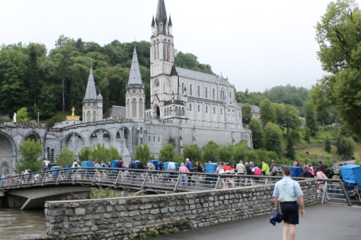
This set of underlying, often unspoken, assumptions is sometimes called ‘the hidden culture’. It influences us in ways that we often fail to recognise. One very startling example of its influence can be seen in situations like World Youth Day or pilgrimages to Lourdes. There, young people, who grow up in an environment where speaking about faith, or displaying commitment to the Church would seem very eccentric, suddenly find themselves in a context where, as one of them put it in the middle of two million young people at the World Youth Day in Rome in 2000, “Here, it’s cool to be Catholic!” It is very interesting to see the dramatic effect of a change in the hidden culture! Unfortunately, after an experience like that they then return to the old ‘hidden culture’ and the effect largely evaporates.
A secularist approach leads to a kind of paradox. On the one hand we are expected to behave as though our deepest convictions have no relevance to politics and social policy. On the other, people wonder why politics awakens so little interest or commitment and the percentage of people who bother to vote declines steadily. It never seems to strike anyone that the two phenomena are connected. If public life has nothing to do with my deepest questions and hopes and fears, why should I feel deeply committed to it?
WORDS – HALLOWED OR HOLLOWED?
There is a further problem. When one tries to speak of God in contemporary culture, one discovers that the very words and concepts in which faith has traditionally been expressed have become a foreign language. Words like, ‘sanctifying grace’, ‘salvation’, ‘church’, ‘heaven’ and ‘hell’ have lost their resonance and, if one might so express it, their power. They tend to be heard as unintelligible, as empty and outdated. It is not just a question of finding other words that might have the kind of depth and power that the traditional words used to have. The problem is, rather, to find and to touch the level of reflection and of openness to the transcendent that would allow the question of God to appear in Pope John Paul’s phrase, ‘above the existential horizon’. This is painfully felt in communications gaps between the generations.
One of the dangers is that, even when we try to engage in that dialogue with the world in which we live, we may do so on too superficial a level. The Second Vatican Council expressed a marvellous vision of the Church as Mystery, as universal sacrament of salvation, as communion in the life of the Triune God, as filled with the Holy Spirit. In the intervening four decades there has, instead, been an overwhelming fascination with the Church as an institution. The Church usually appears in the media only in terms of controversies and issues, personalities and tensions, scandals and divisions, struggles between progressives and conservatives.
Such media attention is not a bad thing in itself, but it highlights the underlying challenge. How, in these circumstances can the Church be presented in a way that will allow people to see it as a sign and instrument of God’s presence? It is not, in the first instance an institution; it is first of all a community which is meant to give witness to, and indeed to be, the presence of Christ in the world through its members. When we speak of the Church we should see it first and foremost a presence to be lived rather than as an institution to be defended or attacked, as the case may be. Would anybody, looking at us from outside, feel moved to exclaim: “See how these Christians love one another!”?
Little that is good is ever said of what people call ‘the institutional church’. This is not surprising because ‘the institutional church’ seems to mean the church considered without any reference to this deep reality. ‘The institutional church’ seems to refer to something that is by definition obsolete and awkward. The proper home of such an entity would be Jurassic Park! The phrase is invariably used in such a way as to suggest that its user has no sense of belonging to or responsibility for the institution. One should always be careful about phrases that are never used except critically. They can sound like clear objective ideas when they are really a statement of one’s opinions. I often think that when people use that phrase they should be asked to specify precisely who or what they mean.
‘Institutional’ here is like the word ‘disgraced’ which is used in the media (disgraced doctor/bishop/politician/businessman) to tell the reader what he or she should think, and who ‘the bad guy’ is even before beginning read what is purporting to be an objective report.
The institutional aspect of the Church is not a thing in itself; it is an aspect of the reality, rather like the human body is an aspect of the human person. The institutional aspect of the Church has no other function than to enable people to be touched by the Mystery of God, to encounter Christ the fundamental Sacrament, to be gathered into the unity of the Holy Spirit.
Although the Church possesses a “hierarchical” structure, nevertheless this structure is totally ordered to the holiness of Christ’s members.
The challenge is how we can speak in way that highlights rather than obscures this deeper reality. The first challenge to any Christian who wishes to engage in dialogue with the secularised world is to try to ensure that we are not so caught up in the institutional aspect of the Church ourselves that even in our own minds the deeper dimension does not appear. If that were the case, then it would hardly be hardly surprising if other people fail to see that dimension.
EXPERIENCING THE HUNGER AND THE WONDER
The central point that I would like to make might be summed up in the phrase, ‘Experiencing the Hunger’. The most crucial element in any attempt to speak about faith today is to touch the deep questions of the meaning of human life, the dignity and destiny of the human person. These are the questions to which faith speaks.
We can speak effectively of faith only if we keep reminding ourselves of the deeper underlying question. Anyone who wishes to engage in dialogue about religion or to speak with conviction about it has to experience the hunger. Otherwise they will never be able to witness to the Gospel promise which is a promise to satisfy the deepest human hungers. The pattern of the incarnation is that the Son of God became one with us, sharing our hunger, our anguish and our death, in order to be able to lead us into the life beyond suffering and death. We cannot skip over the passion and Cross and simply arrive at the glory of resurrection. Before we can understand what it means to say that Christ promises to fulfil our longings, we have to deepen and intensify our longings. It is to those deep longings that the Gospel speaks.
Not the least of the problems about the fact that so many people view the Church as an institution is that no one believes that an institution, a structure, can feel hunger and pain and vulnerability. This is the cry that goes up from many people when they say: Christ yes, but not the Church! People won’t hear the Gospel from a source which they do not perceive as sharing in the anguish of the deepest human questions. Only someone who knows the hunger or who has glimpsed the greatness of the promise can convincingly communicate the wonder of God’s response.
I think of the remarkable passage in Evangelium Vitae in which Pope John Paul speaks about what is needed if we are to celebrate and communicate the Gospel of Life to the world. He speaks of what he calls the contemplative outlook:
It is the outlook of those who see life in its deeper meaning, who grasp its utter gratuitousness, its beauty and its invitation to freedom and responsibility. It is the outlook of those who do not presume to take possession of reality but instead accept it as a gift, discovering in all things the reflection of the Creator and seeing in every person his living image.
I think of an address that Paul VI gave to his priests when he was Archbishop of Milan:
Let us try to keep our eyes open, to learn how to marvel… St. Augustine says, ‘The fountain is greater than my thirst.’ And I must marvel at this. I must always be ready to marvel, to feel amazement; and the old things that I have celebrated for so many years must always appear to me as something new. The birth of Jesus, his passion, his death, the coming of the Holy Spirit. All these mysteries that gradually will become habit, must become fresh again, immediate, and I must rejoice at their greatness… To see! To see!
I think, finally, of the poet Emily Dickinson, who spoke for many poets and artists when she wrote, “‘Consider the lilies’ ( Mt 6:28) is the only commandment I ever obeyed” – in other words, the commandment to wonder and to contemplate.
I want to look at some of the areas where people can experience the hunger for God. But I stress that we must first experience that hunger and that wonder ourselves. That is not something that is we are prompted to do by our ‘hidden culture’.
BEWILDERED AND RESTLESS
One sign of hope for the task of speaking about God today may be this – when I began to prepare these thoughts I felt that I might point to a few cracks in the wall that separates our secularised existence from its deeper roots. As I reflected it seemed to be that the wall is very much less solid than it appears and that the cracks are far too numerous to do any more that point briefly to some of them. The situation is not as hopeless as it might seem.
In previous eras, the questions of God, of death and meaning, of judgement and eternal life were close to people’s consciousness. Those questions occupied people’s thoughts and their prayers. They obviously arise in the life of individuals, since no one can escape the experiences of illness and bereavement. But these experiences are less part of the life of the community than they were. Of course we still attend funerals and are concerned for the bereaved, but we can push death out of our consciousness in a way that was not possible in a more intimate society. We need to be more alert if we are to detect and respond to the relatively rare moments when such questions may be close to the surface in a more than individual way.
One of the reasons why traditional sacred words seem to have lost their power is that the experience to which they are addressed is pushed out of public discourse and when the questions do arise, as they do at certain points in every life, many people do not look to the Church or the Gospel for a response that would give meaning.
Only people who have learned to reflect and pray and open their hearts to the promise of God will be able or ready to see the profound meaning of the crises and experiences that arise, sometimes unpredictably, in the life of individuals and in the life of society. The world which appears to be self-contained and without the capacity to hear the deepest questions can, sometimes quite unexpectedly, show that beneath the affluence and advances, we are, in a phrase used by Pope John Paul, “bewildered and restless”.
SEPTEMBER 11 TH
Just over six years ago we welcomed the year 2000 with great hopes for a century of peace and progress. In 2001, illusions were shattered. The image that may have set the theme for the 21 st century may be the planes flying into the twin towers and their subsequent collapse.
In Ireland we responded spontaneously and very wholeheartedly. Churches all over the country were packed for hastily arranged Masses, ecumenical and interfaith services. On reflection, some time later, priests were heard ruefully reflecting on the fact that a couple of years earlier they had marshalled every resource to gather people for Jubilee celebrations. While the response was good, it simply did not compare to this spontaneous outpouring of prayer with huge attendance at events that, because of the time scale, had scarcely even been publicised!
This and other spontaneous gatherings, like the response to the visit of the relics of St Thérèse to Ireland, like the prayers and the generous response to the victims of disasters like the tsunami, like the continuing attraction of pilgrimage centres, Lourdes Knock, Lough Derg etc., is worth thinking about. The numbers of people going to Rome to attend Papal audiences, and the Pope’s Sunday Angelus continue to rise and for the last year are more than twice as high as they have ever been. The line of visitors to the tomb of Pope John Paul still snakes every day around the vast colonnades around St Peter’s Square.
We might take September 11 th as an example of these moments when we see things differently – when our ‘hidden culture’ suddenly seems fragile and unconvincing and we break out of the notion that we should keep our religion to ourselves. No response of ours - military might, the political pursuit of justice, attempting to support peace processes in troubled regions, sending relief and development aid - can undo the realisation of how vulnerable we are.
September 11th brought us face to face with something fundamental about ourselves. However much we work to make the world a better place, however powerfully we combat threats, however great our achievements, we are flawed and mortal. All those we love are fragile and fallible. Nothing in this world is perfect; nothing lasts forever. The collapse of the towers showed us a truth, which we would be foolish to forget.
The prophet, exiled in Babylon, wanted God to intervene mightily in history as in times past, slaying dragons, drying up the sea and bringing the chosen people safely home from exile and danger. So, he prayed: "Awake, awake, put on strength, O arm of the Lord" (Isaiah 51:9). He looks to the time when the Lord will indeed have "bared his holy arm" (52:10). Part of that prophecy is read at Mass on Christmas morning to celebrate the fact that the Lord has awoken and bared his holy arm. But where is its strength? It does not carry powerful weapons or wield irresistible force. It is the fragile arm of a tiny baby. God does not come to surround us with an armour plate of invulnerability. If we face the uncertainty of life, if we recognise the unreliability of our hopes and expectations, if we seriously reflect on the inevitability of death, we may begin to see how extraordinary the truth is. God's eternal Son is born in a stable in order to be vulnerable with us. At the end of his life the arm of Jesus is bared once more - and brutally nailed to a cross.
There is no armour plate of invulnerability. The World Trade Centre was a massive structure, apparently impregnable. The Spielberg film AI had a scene set in New York thousands of years from now. I believe they had to re-shoot the scene because in the original version all that could be seen over the greatly raised sea level was the top of the twin towers! How wrong one can be about what seems to be indestructible!
We are not invulnerable. It is self-deception to imagine we are secure and indispensable because of our achievements, reputation, possessions or talents. Nowhere on the planet would one have found so many high achievers, so many highly regarded, wealthy and talented people as in the twin towers. When the planes struck, those were not the things that mattered. People were using their mobile phones not to close important deals but to tell someone how much they loved them.
There are many potential cracks in the wall which usually prevents people from addressing their most fundamental questions. Such events could be fruitful starting points for the dialogue of faith and a largely non-believing culture.
DISILLUSIONMENT
Another area of bewilderment is the sense of disillusionment that marks a great deal of modern life – disillusionment with institutions and with public figures, disillusionment about one’s own relationships, disillusionment that leads to drug abuse and to despair. A young drug addict was asked in a radio interview a couple of years ago what he was trying to escape from. He replied “from the fact that I exist”.
It is a disillusionment that looks for excitement and thrills which, in the end, wear thin. A priest, who is also a qualified pilot instructor, once told me that he brought a few tough young lads up in small plane and thought that he might be able to show them something about their own vulnerability. He stalled the engine and allowed the plane to fall – as one does in training sessions. When he restarted the engine and pulled out of the dive, he expected that they might be somewhat chastened. Instead they were highly excited, saying “Do it again, Father!” They would risk anything for a thrill. It is amusing, but also sad; in it one fears that one is glimpsing lives that are experienced as empty and disillusioned, ready to take any risk to escape from the dull routine lacking a sense of hope/
We human beings are, in our deepest hearts, seeking for something. We long to satisfy our deepest hungers for truth, joy, beauty and goodness. We want to be able to trust people, to believe that people can be relied on to be generous, truthful and trustworthy. We want our own relationships to be faithful. The marriage promise looks to a relationship which can face a future that may bring good or bad fortune, riches or poverty, sickness or health, a relationship which is meant to endure whatever may happen. The pain of broken relationships or betrayed trust is so intense because we believe that something greater is possible. We are made for better things.
This too is a starting point for dialogue with the Gospel which promises a life where every human being will be utterly reliable and we ourselves will be utterly reliable because we live in the presence of God, sharing in the infinite faithfulness by which he betroths us to himself forever in uprightness and justice, in faithful love and tenderness ( Cf. Hos 2:21).
One might also point to other experiences such as moral relativism and consumerism. For the first time in history, many people can find no agreed source or criteria for discovering what is right or wrong. To a degree that never was present before, people are invited to fill needs that didn’t exist till they saw the advertisement, while, at the same time, escaping from the deep needs which are the essence of our humanity.
HELPLESSNESS
It is often said that there is, in the modern world, a lack of the sense of sin. This is undoubtedly true, but it is also true that there is, in the modern world, a great sense of guilt. Pope John Paul, in Dives in Misericordia, speaks of the threats which exist in our world through war and oppression. Then he says:
All this is happening against the background of the gigantic remorse caused by the fact that, side by side with wealthy and surfeited people and societies living in plenty and ruled by consumerism and pleasure, the same human family contains individuals and groups that are suffering from hunger…. That is why moral uneasiness is destined to become even more acute. It is obvious that a fundamental defect, or rather a series of defects, indeed a defective machinery is at the root of contemporary economics and materialistic civilisation, which does not allow the human family to break free from such radically unjust situations.
The divisions between wealth and poverty, war and peace, are much more acute in the world of modern communications. People in the Western world saw, for instance during the war in the Balkans, live pictures of bombs and artillery, raining down on apartments and houses not too different from our own, containing television sets and computers and dishwashers just like ours. We have seen death and destruction suddenly striking modern cities like New York, Madrid and London.
We have also seen starving people exposed to the most hostile weather conditions while we are actually in the process of eating a good meal sitting in a well heated or air conditioned house. It is not possible to avoid the realisation that one’s trivial and routine expenditure – on a newspaper or a cup of coffee – could feed a starving child. It is not possible to ignore the fact that some of our brothers and sisters are suffering dreadfully while we live in what they would regard as unimaginable luxury.
At the same time we realise that greater personal generosity, desirable, useful and obligatory though that is, will not cure the defective machinery at the root of the problems. We do not know how to repair the economic system. Yet we also know in our hearts that one of the chief forms of social sinfulness is to fail to eliminate or limit social evils “out of laziness, fear or the conspiracy of silence… (through taking) refuge in the supposed impossibility of changing the world”.
We know also that for all the technological development and wealth creation we have seen in recent decades, justice for all remains beyond our grasp. And we know that in the wider picture of the human race throughout history, millions of our brothers and sisters are beyond any material help that we will ever be able to give, because they are already dead.
The hunger for a world of fairness and peace is suppressed because we feel that it is unrealistic. As with the hunger for meaning and the hunger for perfection, what is needed is not to diminish this hunger but to experience it more fully. The experience of that hunger is a crack in the wall of self-sufficiency. The meaning of human life cannot simply depend on the time or place of one’s birth. If life is absurd for some human beings, it is absurd for all of us. That threat of absurdity may open people’s minds to hear of the God who offers vindication and justice to the living and the dead. In the light of such a vision, the “gigantic remorse” can be transformed into a sense of sin against the God whose merciful love is without limit. It can thus become a source of hope.
Only a person who has felt the hunger for justice can begin to appreciate the God who is the source and guarantee of the dignity of every human being. In the light of that vision, the real challenge is not to make hopeless attempts to achieve the impossible. The real challenge is to see that the meaning of human life lies not in the acquisition of goods but in sharing ourselves. This was one of the ideas expressed by the Irish bishops in the pastoral letter on the economy published a couple of years ago:
Divine revelation helps us to see that either wealth is shared, or its owners become the owned and are diminished in themselves. This is a message that is liberating for rich and poor alike, each of whom is invited to see through the falseness of making material possessions the goal of human life and to experience the joy that the Spirit of God gives in the act of sharing.
The hunger for justice is a field in which the dialogue of faith and culture can take place. So too, is the hunger for peace.
THE LOVE THAT MOVES THE UNIVERSE
Here we are at the core of the question of Faith today. Is it true that we are simply at the mercy of events that are too big for us to control? Even if we all worked together, we could not solve every problem. Even if we could transform the world in a generation, what about all the generations that have died and who are beyond our power to help. Feeling the hunger could easily lead us to take refuge in the supposed impossibility of changing the world.
This is the question that the present Holy Father has been addressing from the beginning of his ministry as Pope. On the day of the solemn inauguration of his pontificate, he spoke of the hunger and the pain:
… there are so many kinds of desert. There is the desert of poverty, the desert of hunger and thirst, the desert of abandonment, of loneliness, of destroyed love. There is the desert of God’s darkness, the emptiness of souls no longer aware of their dignity or the goal of human life. The external deserts in the world are growing, because the internal deserts have become so vast. Therefore the earth’s treasures no longer serve to build God’s garden for all to live in, but they have been made to serve the powers of exploitation and destruction. The Church as a whole and all her Pastors, like Christ, must set out to lead people out of the desert, towards the place of life, towards friendship with the Son of God, towards the One who gives us life, and life in abundance .
The external deserts are growing. Anyone who looks around must wonder what kind of world today’s young people will inherit, with energy crises and struggles for basic resources such as water, with climate change, and terrorism that seems impossible to defeat, with the possibility that privacy will virtually disappear because of the combined influence of security fears and the availability of increasingly intrusive technology. One could go on… We are here looking back on fifty years in the life of this parish, years of dramatic change. Can we doubt that the changes of the next fifty years will be even more startling?
The internal deserts are vast. Where are we to find a sense of meaning in life? How can we face a world in which, even if we can say, “I’m all right, Jack” that can only be by not looking at brothers and sisters who live in conditions that we can hardly contemplate?
Here is the essence of the challenge that faces us: how to awaken and hold on to a sense of hope which is big enough. If it is big enough, it is too big for a matter-of-fact world (that never cultivates a contemplative outlook) to grasp. We need to find a language and a way of life, first of all for ourselves, which will reveal the joy and the human richness and the power of Christ’s promise which is what we seek in all our longings, though we rarely recognise it.
We do not need to suppress our hopes and damp down our desires in the cynicism which believes that “if something can go wrong, it will”, or that “blessed is he who expects nothing for he shall not be disappointed”.
We need rather to open our minds to the realisation that we are made for something greater, that the trouble with our hopes is not that they are too big but that they are too small. We really begin to understand our hopes and longings when we begin “to grasp the breadth and the length, the height and the depth, so that, knowing the love of Christ which is beyond knowledge, [we] may be filled with the utter fullness of God” ( Eph 3:18).
To put it another way, it is true that our efforts to make everything right in the world will never be enough. But God is making all things new. Our efforts are efforts to be part of what God is doing. Vatican II put it this way:
The Word of God through whom all things were made, became man and dwelt among us, a perfect man, he entered world history, taking that history into himself and summing it up. He assures those who trust in the charity of God that the way of love is open to all and that the effort to establish a universal communion will not be in vain.
God’s promise shatters the limited nature of even our highest hopes. In other words, we need to be stretched in order to grasp the fullness of God. St. Augustine said:
Suppose you want to fill some sort of bag... You know how big the object is that you want to put in and you see that the bag is narrow so you increase its capacity by stretching it. In the same way by delaying the fulfilment of desire God stretches it, by making us desire he expands the soul, and by this expansion he increases its capacity.... That one syllable [God] contains all that we hope for... Let us stretch ourselves out towards him so that when he comes he may fill us .
That is what Pope Benedict’s encyclical is telling us. A couple of days before he published it, he explained how, in writing it, he had been inspired by the vision of the poet Dante. After a long journey, the poet describes his arrival at the brilliant light of God’s presence. And what he finds is that this dazzling light is “the love that moves the sun and the other stars”.
Two things in particular impressed the Pope about Dante’s vision. First of all, “Light and love are one and the same. They are the primordial creative power that moves the universe”. Even more strikingly, the poet tells us that this light, “ Within itself and in its colouring, seemed to be painted with our human likeness ” . The light and love that move the universe, as the Pope put it, “have a human face and… a human heart”. The love of God is made visible in Jesus Christ.
THE EUCHARIST
We are back to the day when I served the first Mass celebrated in the new Church of St Therese; I have been taking about what we celebrate in the Eucharist. I had hardly begun to grasp that on the day 50 years ago. The Eucharist is the presence among us of the love that moves the universe, painted with our human likeness. It is the core of everything that exists: the core is unlimited and unconquerable love – God’s Son cruelly killed by human beings and in that very act bringing us into a life beyond evil, suffering and death.
We sometimes think of the Eucharist as a kind of motorway services area into which one pulls aside out of the bustle of the real world in order to refresh oneself. The Eucharist is at the very centre of the real world. It is the Reality which alone gives meaning to the chaos of human lives and human history. It is not a lay-by; it is the Road: He is the Way. Anything which does not in some way share in the truth made present in the Eucharist is at best a lay-by and at worst a road that speeds one in the wrong direction, away from the destination.
When we get lost in the busy-ness and turmoil of life and do not lift our eyes to the staggering truth, or when we begin to take it for granted, we begin to miss the truth and get involved in the pursuit of what could never satisfy us. The mythology of consumerism promises wealth and prestige, comfort, fitness, success. But it is a mythology that blinds. As Ronald Rolheiser puts it: “When we stand before reality self-preoccupied, we will see precious little of what is actually there to be seen. Moreover, even what we do see will be distorted and shaped by self-interest.... Our sense of reality shrinks accordingly...”.
This is the heart of what we are about. The temptation in a secularised world is to get on with the “bits” of the Gospel that “work”. We can speak of good neighbourliness and decent moral standards and these are certainly required of the followers of Christ, but such qualities can easily coexist with attitudes that shrink our sense of reality. They have their own value and may be a way of opening a person up to the Good News. But we must be clear: the Gospel properly speaking is about awakening and addressing the hunger for absolute fulfilment. It is about the hunger which only God can satisfy.
At the beginning of his encyclical, Pope Benedict summed up the essence of what we are about: “We have come to believe in God’s love: in these words the Christian can express the fundamental decision of his life” Here is where we have to find the antidote to secularism the answer to the challenge of faith today. It will not be found in condemnations or in coercion. It will be found in seeking the Truth which is richer, more satisfying, more liberating, more human, more worthy of our wholehearted commitment and effort than anything else.
The answer to the one-dimensional, impoverished worldview of secularism will come from people who are “steeped in the truth which comes from Christ” as Pope John Paul put it in the Phoenix Park. Christ shows us a hope which gives a whole new dimension to our understanding of ourselves. When we look at ourselves in the light of our redemption in Christ, as Pope John Paul put it in his first encyclical, we are filled with a deep amazement at human worth and dignity which is called the Gospel.
THE CHALLENGE
The complexity of modern life is both a challenge and an opportunity to recognise God’s presence. Even committed Christians live most of their lives in circumstances which have never before been touched by the Gospel. No Christian before our time has been involved in multi-national companies, the Internet, the advances of technology, growing urbanisation, globalisation, multi-culturalism; none of these have existed in the same way before. The danger is that large sections of the lives even of believers remain untouched by the Gospel. In many cases individual Christians – still less groups of Christians – have not thought and prayed and talked about what the presence of Christ in these areas might mean. But if that is the case, does this not mean cooperating with the notion that God has only a limited place in our lives and that in large tracts of life God is not relevant? If that is so, there is no use complaining about how secular the world has become and how deaf to deeper values. If that so, we are creating and maintaining a hidden culture which excludes God and also excludes our deeper selves.
It is not that we should intrude religious considerations in the workplace or the club in a way that is pushy or offensive. The first step is not to talk about religion at the golf club bar, but to reflect first of all for myself that golf and friendship are part of my life and, therefore, part of my journey to God, part of my following of Christ. Here too, and in every corner of my existence, I am meant to “ see life in its deeper meaning… and seeing in every person (the Creator’s) living image”.
Although questions arise for different individuals in an often unpredictable way, there are broad areas where we have to find ways of reflecting as individuals and as groups on a more ongoing basis. One example is a crying need for reflection on the social teaching of the Church, the implications of a deep understanding of human dignity in the light of Gospel for how one understands the economy, work, social justice; art, science, health care, the media.
Most important of all is what needs to happen in the heart of every believer. Unless we experience the hunger for meaning, we cannot involve others in a dialogue based on that search.
Fifty years ago, ensuring that our community would continue to have faith in Christ, may not have struck us as much of a challenge. Nowadays we can have little doubt about it! But maybe our situation is the opportunity for a truer and richer faith. Opening our lives to the wonder of the God who is love is, and has always been, a very demanding challenge. St Augustine said about God, “If you know him, it is not he!” Pope John Paul did not minimise the challenge:
“The gift (of faith) must become a task, which must shape the whole Christian life: ‘This is the will of God, your sanctification’ (1 Thess 4:3). It is a duty which concerns not only certain Christians: ‘All the Christian faithful, of whatever state or rank, are called to the fullness of the Christian life and to the perfection of charity”
“It would be a contradiction to settle for a life of mediocrity, marked by a minimalist ethic and a shallow religiosity… It would be wrong to think that ordinary Christians can be content with a shallow prayer that is unable to fill their whole life”
Believing today is not just a gift; it is a very demanding task.
JOHN PAUL II, 5 March 1988.
JOHN PAUL II, Centesimus Annus, 24.
Cf. TERTULLIAN, Apologeticus, 39.
JOHN PAUL II, Mulieris Dignitatem, 27.
JOHN PAUL II, Evangelium Vitae, 83.
MONTINI, J. B., The Priest, Helicon Dublin 1963, p. 137.
Quoted in Norris, K., The Cloister Walk, Riverhead, New York, 1996, p.222.
JOHN PAUL II, Catechesi Tradendae, 61,
JOHN PAUL II, Dives in Misericordia, 11.
JOHN PAUL II, Reconciliatio et Paenitentia, 16
IRISH CATHOLIC BISHOPS’ CONFERENCE, Prosperity with a Purpose, Veritas 1999, 173
. BENEDICT XVI, Homily at the solemn inauguration of his pontificate, 24 April 2005.
AUGUSTINE, Homily on the first letter of John , Office of Readings Friday Week 6.
Divina Commedia XXXIII, 145
BENEDICT XVI, Address to Cor Unum, 23 January 2006.
Divina Commedia XXXIII, 130
. Address to Cor Unum.
The Shattered Lantern, p. 27
BENEDICT XVI, Deus Caritas Est, 1.
JOHN PAUL II, Homily in the Phoenix Park, 29 September 1979.
Redemptor Hominis 10
JOHN PAUL II, Evangelium Vitae, 83
. AUGUSTINE, Sermon 52, Cf. Deus Caritas Est, 38.
Novo Millennio Ineunte , 30.
Novo Millennio Ineunte, 31, 34.
+Donal Murray
Bishop of Limerick
|